
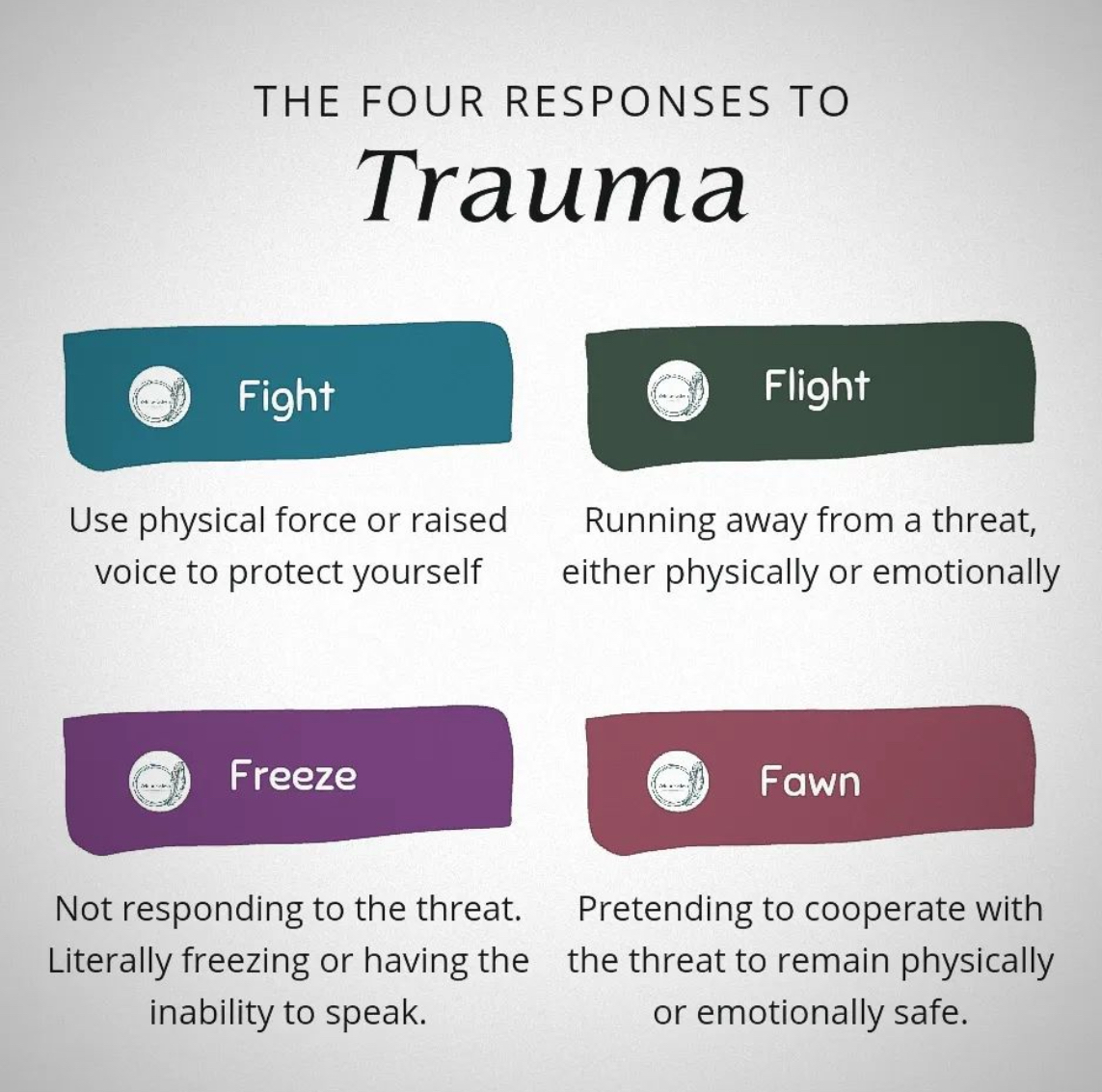

Trauma Responses - the 4 f's
Dear Clients,
Trauma is an extreme emotional reaction to an overwhelmingly negative event. People react differently to trauma based on lived experiences, level of resilience, coping skills etc. When a person experiences a traumatic event, they will respond in one of four ways: fight, flight, freeze or fawn.
There are many theories regarding the way that people respond to trauma, however, it is important to note that a person's reaction to trauma is involuntary and is done subconsciously. A person does not choose to respond in one way or the other.
Scenario: Let's say that you are riding your bicycle down the street and suddenly a dog jumps over a boundary wall and charges directly at you.
F1 - Fight
This reaction involves the use of physical force or a raised voice to try to defend one's self against a possible threat. In the scenario above, you may yell at the dog or place the bicycle between you and the dog to discourage it from biting you. Although you are responding with a fight, it does not necessarily mean that you are a violent person or someone with anger issues.
F2 - Flight
The first reaction is to run away from the threat physically or emotionally. In this scenario, you may find yourself pedaling faster to get away or you may drop the bicycle to climb a nearby tree. The action of running away from the threat does not mean that you are a coward or that you are too weak to fight back.
F3 - Freeze
This reaction involves the inability to move or speak and freezing in one place. In this scenario, you cannot run away or yell at the dog. This response does not mean that you are too 'stupid' to think or unable to make a decision under pressure.
F4 - Fawn
This reaction involves cooperating or complying with the threat to remain physically and emotionally safe. In the scenario, you may yell that you are not a threat or move slowly hoping the dog does not bite you. If the dog stops near you, you speak in a soft tone of voice to show that you are not a threat. This response does not mean that you wanted the dog to charge at you or that you secretly hoped to get bitten.
Regardless of how you respond to trauma, know that these four reactions are completely normal and are influenced by the type of trauma you are experiencing. This implies that it is just as normal for you to experience the same type of reaction to every traumatic event as it is to experience multiple different reactions. There is no way to determine how you will respond ahead of time.
Be blessed,
Madeleine